Grant County Dog Registration Information
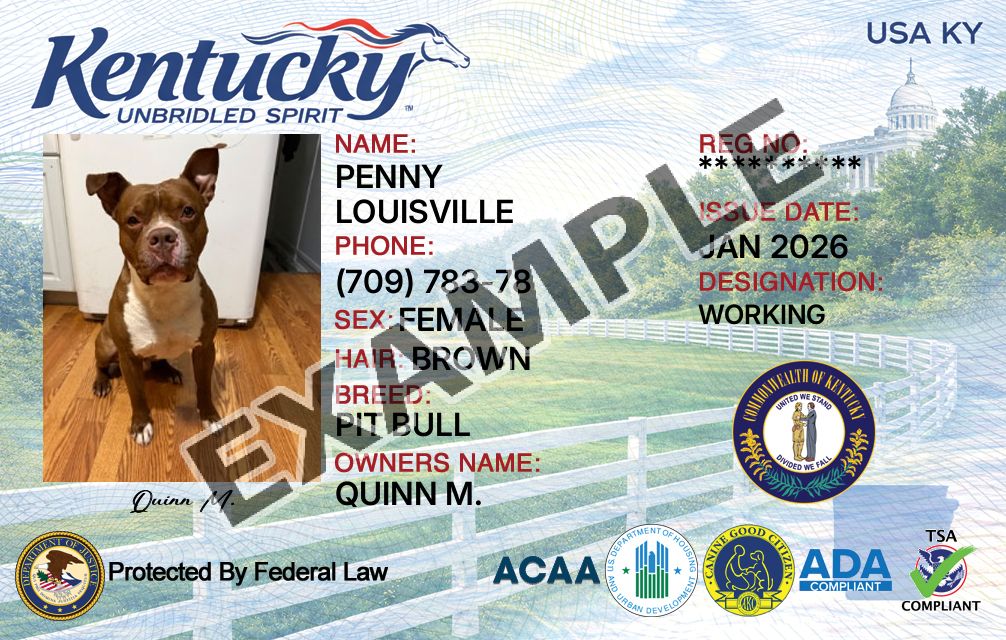
Service Dogs and Emotional Support Animals in Grant, Kentucky
If you’re asking “where do I register my dog in Grant County, Kentucky for my service dog or emotional support dog,” it helps to separate two different things: (1) local dog licensing / rabies tag compliance and (2) your dog’s service dog or emotional support animal (ESA) status. In Grant County, licensing and animal services questions are typically handled through county animal shelter/animal services and (for public health topics like rabies vaccination clinics) the local health department.
- Dog licensing (sometimes called a “dog license,” “registration,” or “tag”) is a local requirement and is usually tied to proof of rabies vaccination.
- Service dogs and emotional support animals are not registered through one universal federal government registry. Service dog rights come from disability laws; ESAs are typically supported by documentation for housing-related accommodations.
- Even if your dog is a service dog or ESA, you may still need to follow local rules for rabies vaccination, leash requirements, and any applicable dog license in Grant County, Kentucky.
Where to Register or License Your Dog in Grant County, Kentucky
The offices below are official local government or public agencies that serve Grant County residents for animal services and related public health needs. If you live inside a city limit, you may also have city-specific rules; when in doubt, start with Grant County’s animal shelter/animal services and confirm whether your address falls under county-only rules or a city ordinance.
Grant County Animal Shelter (Grant County Fiscal Court)
| Monday | 12:00 PM – 6:00 PM |
| Tuesday | 12:00 PM – 5:00 PM |
| Wednesday | 12:00 PM – 5:00 PM |
| Thursday | 2:00 PM – 6:00 PM |
| Friday | 12:00 PM – 4:00 PM |
| Saturday | Closed |
| Sunday | Closed |
| Holidays | Closed |
Grant County Health Center (Northern Kentucky Health Department)
Grant County Fiscal Court (General County Directory / Main Office)
Overview of Dog Licensing in Grant County, Kentucky
What “registering” a dog usually means locally
In many Kentucky communities, “registering a dog” means obtaining a local dog license or tag and keeping current proof of rabies vaccination. Rules can be set by county ordinance and, in some cases, by cities within the county. That’s why residents searching for “where to register a dog in Grant County, Kentucky” should confirm requirements based on where the dog is kept (your physical address).
County vs. city requirements inside Grant County
Some counties have a countywide approach, while others may have city rules layered on top. If you live inside a municipality (for example, within a city limit), ask the animal services office:
- Whether your household follows county-only rules or city-specific licensing rules
- Whether a dog license/tag is required annually or only when rabies vaccination is updated
- Whether there are different fees for altered (spayed/neutered) vs. unaltered dogs
- Whether service dogs have any fee differences locally (if applicable)
Rabies vaccination and identification
Regardless of whether a separate “license” is required, rabies vaccination is a foundational requirement in many local animal control programs. In practice, licensing transactions often require proof of a current rabies vaccination, and dogs may be required to wear a rabies tag and/or a county/city license tag.
Dog License vs. Service Dog vs. Emotional Support Animal (ESA)
| Category | What it is | Who issues/recognizes it | Typical documentation | Common misunderstanding |
|---|---|---|---|---|
| Dog license (local registration) | A local license/tag program (if applicable) used for identification, compliance, and animal control administration. | County/city animal services or another local government office (varies by locality). | Proof of current rabies vaccination; owner contact info; sometimes proof of spay/neuter. | “My service dog/ESA doesn’t need a license.” In many places, local vaccination and licensing rules still apply. |
| Service dog | A dog individually trained to do work or perform tasks for a person with a disability. | Recognized under disability law based on training and handler disability-related need (not a universal registry). | No universal government registration; in public access settings, businesses may ask limited questions about tasks. | “I need to buy a certificate/ID online.” Typically, legal status is based on training and function, not a purchased registration. |
| Emotional support animal (ESA) | An animal that provides comfort by its presence; not required to be task-trained like a service dog. | Most commonly relevant in housing accommodations under fair housing rules; not a public-access designation like service dogs. | Generally, documentation from a qualified healthcare provider may be requested for housing-related accommodation. | “An ESA can go anywhere.” ESAs are not automatically allowed in public places where pets are prohibited. |
If your question is specifically about “registering” a service dog or ESA in Grant County, Kentucky: you’re typically looking for local licensing (if required) plus the correct way to document your need for accommodations (service dog tasks; ESA housing documentation), rather than a separate county-issued “service dog registry.”
What You Need Before Registering a Dog
Common documents and information requested
While exact dog licensing requirements in Grant County, Kentucky can vary based on local rules, many licensing offices commonly ask for:
- Proof of current rabies vaccination (certificate from your veterinarian)
- Your contact information (name, address where the dog is kept, phone)
- Dog description (breed, color/markings, age, sex)
- Spay/neuter documentation (if fees differ based on altered status)
- Payment method for any local licensing or tag fee (if applicable)
If the dog is a service dog or ESA
Your dog’s role as a service dog or emotional support animal usually does not change the basic local process of confirming rabies vaccination and keeping the dog properly identified. However, it can matter in specific contexts:
- Service dog: Focus on training and task performance; keep vaccination/ID current like any other dog.
- ESA: Most relevant for housing accommodation requests; the “registration” people talk about is typically not a government license, but documentation supporting the need for accommodation.
Steps to Register or License a Dog in Grant County, Kentucky
Step 1: Confirm which local rules apply to your address
Because local requirements can differ by jurisdiction, start by confirming whether your residence follows county rules only or whether a city ordinance adds additional requirements. If you are unsure, contact the Grant County Animal Shelter/animal services first and ask how dog licensing is handled for your address.
- Ask: “Do you issue a county dog license or tag?”
- Ask: “What proof is required—rabies certificate, spay/neuter record, ID?”
- Ask: “Do I need to renew annually, and where do I renew?”
Step 2: Make sure rabies vaccination is current
If your dog is not current on rabies vaccination, schedule vaccination through a veterinarian. If you’re looking for public health guidance or vaccine clinic information, the Grant County Health Center is a reliable place to ask about local options and rabies-related public health requirements.
Step 3: Bring your documentation (or confirm what can be submitted)
Some offices can process licensing or tag-related needs with documentation in person during office hours; others may have specific procedures. To avoid extra trips, call first and confirm what to bring and whether any forms are required.
Step 4: Keep tags and records accessible
After you license/register your dog (if required), keep a copy of key documents:
- Rabies vaccination certificate
- Any license receipt or tag number (if issued)
- Microchip information (if your dog is microchipped)
Service Dog Laws in Grant County, Kentucky
No universal federal service dog registry
Service dogs are defined by what they do: they are trained to perform tasks for a person with a disability. There isn’t one universal federal government registry that you must use to “register” a service dog. In day-to-day life, service dog status is generally established by training and the handler’s disability-related need, not by an online certificate.
Local licensing vs. service dog status
A local dog license in Grant County, Kentucky (if required) is separate from service dog legal status. Even as a service dog handler, you should expect that:
- Rabies vaccination rules still apply.
- Leash/control rules still apply unless a specific exception is needed for task performance.
- Local identification (tags) may still be required depending on the jurisdiction.
Practical tips for service dog handlers
- Keep a copy of your dog’s rabies certificate in your records.
- If your dog wears tags, ensure they’re current and legible.
- If you move within Grant County (or into/out of a city limit), re-check local licensing requirements.
Emotional Support Animal Rules in Grant County, Kentucky
ESA “registration” vs. local dog licensing
Emotional support animals are not the same as service dogs and are not defined by task training. If you’re searching for “where do I register my dog in Grant County, Kentucky for my emotional support dog,” it usually means one of two things:
- Local licensing: If your area requires a dog license/registration, you’ll follow that local process (often involving proof of rabies vaccination).
- Housing accommodations: If you need an accommodation related to housing, documentation may be requested by a housing provider. This is separate from any county licensing step.
Public access and ESAs
ESAs generally do not have the same public access rights as service dogs. That means an ESA may not be permitted in places where pets are prohibited, even if the animal provides emotional support. If you need help sorting out whether your situation is best addressed as a service dog need or an ESA accommodation need (especially for housing), consider speaking with a qualified professional familiar with your circumstances.
Frequently Asked Questions
Do I need to register a service dog with Grant County to make it “official”?
Typically, no. There is not one universal federal government registry for service dogs. However, you may still need to comply with local rules such as rabies vaccination and any dog license in Grant County, Kentucky (if required for your address). When in doubt, confirm with the Grant County Animal Shelter/animal services.
Where do I get a dog license in Grant County, Kentucky?
Start with the official local animal services contact: the Grant County Animal Shelter. They can tell you whether the county issues a dog license/tag, what documents are required, and whether your city (if you live in a city limit) has additional requirements.
Do I need proof of rabies vaccination to register or license my dog?
Often, yes—local licensing and animal control identification programs commonly require proof of a current rabies vaccination. If you have questions about rabies clinics or public health guidance, the Grant County Health Center can be a helpful official resource.
If my dog is an ESA, do I still have to follow animal control rules?
Yes. ESA status generally doesn’t remove requirements related to rabies vaccination, leash/control, nuisance rules, or any local licensing requirements. ESA status is most often relevant for housing accommodations, which is separate from animal control licensing.
What if I live in a city within Grant County?
Requirements can vary by municipality. If your address is inside city limits, ask the Grant County Animal Shelter whether your dog licensing requirements are handled at the county level, the city level, or both. If you’re not sure who has jurisdiction, the Grant County Fiscal Court office can help route you to the correct official department.
Register A Dog In Other Kentucky Counties
Select your county below to get started with your dog’s ID card. Requirements and license designs may vary by county, so choose your location to see the correct options and complete your pup’s registration.
- Adair County Dog Registration
- Allen County Dog Registration
- Anderson County Dog Registration
- Ballard County Dog Registration
- Barren County Dog Registration
- Bath County Dog Registration
- Bell County Dog Registration
- Boone County Dog Registration
- Bourbon County Dog Registration
- Boyd County Dog Registration
- Boyle County Dog Registration
- Bracken County Dog Registration
- Breathitt County Dog Registration
- Breckinridge County Dog Registration
- Bullitt County Dog Registration
- Butler County Dog Registration
- Caldwell County Dog Registration
- Calloway County Dog Registration
- Campbell County Dog Registration
- Carlisle County Dog Registration
- Carroll County Dog Registration
- Carter County Dog Registration
- Casey County Dog Registration
- Christian County Dog Registration
- City of Lexington County Dog Registration
- City of Louisville County Dog Registration
- Clark County Dog Registration
- Clay County Dog Registration
- Clinton County Dog Registration
- Commonwealth of Kentucky County Dog Registration
- Crittenden County Dog Registration
- Cumberland County Dog Registration
- Daviess County Dog Registration
- Edmonson County Dog Registration
- Elliott County Dog Registration
- Estill County Dog Registration
- Fayette County Dog Registration
- Fleming County Dog Registration
- Floyd County Dog Registration
- Franklin County Dog Registration
- Fulton County Dog Registration
- Gallatin County Dog Registration
- Garrard County Dog Registration
- Graves County Dog Registration
- Grayson County Dog Registration
- Green County Dog Registration
- Greenup County Dog Registration
- Hancock County Dog Registration
- Hardin County Dog Registration
- Harlan County Dog Registration
- Harrison County Dog Registration
- Hart County Dog Registration
- Henderson County Dog Registration
- Henry County Dog Registration
- Hickman County Dog Registration
- Hopkins County Dog Registration
- Jackson County Dog Registration
- Jefferson County Dog Registration
- Jessamine County Dog Registration
- Johnson County Dog Registration
- Kenton County Dog Registration
- Knott County Dog Registration
- Knox County Dog Registration
- LaRue County Dog Registration
- Laurel County Dog Registration
- Lawrence County Dog Registration
- Lee County Dog Registration
- Leslie County Dog Registration
- Letcher County Dog Registration
- Lewis County Dog Registration
- Lincoln County Dog Registration
- Livingston County Dog Registration
- Logan County Dog Registration
- Lyon County Dog Registration
- Madison County Dog Registration
- Magoffin County Dog Registration
- Marion County Dog Registration
- Marshall County Dog Registration
- Martin County Dog Registration
- Mason County Dog Registration
- McCracken County Dog Registration
- McCreary County Dog Registration
- McLean County Dog Registration
- Meade County Dog Registration
- Menifee County Dog Registration
- Mercer County Dog Registration
- Metcalfe County Dog Registration
- Monroe County Dog Registration
- Montgomery County Dog Registration
- Morgan County Dog Registration
- Muhlenburg County Dog Registration
- Nelson County Dog Registration
- Nicholas County Dog Registration
- Ohio County Dog Registration
- Oldham County Dog Registration
- Owen County Dog Registration
- Owsley County Dog Registration
- Pendleton County Dog Registration
- Perry County Dog Registration
- Pike County Dog Registration
- Powell County Dog Registration
- Pulaski County Dog Registration
- Robertson County Dog Registration
- Rockcastle County Dog Registration
- Rowan County Dog Registration
- Russell County Dog Registration
- Scott County Dog Registration
- Shelby County Dog Registration
- Simpson County Dog Registration
- Spencer County Dog Registration
- Taylor County Dog Registration
- Todd County Dog Registration
- Trigg County Dog Registration
- Trimble County Dog Registration
- Union County Dog Registration
- Warren County Dog Registration
- Washington County Dog Registration
- Wayne County Dog Registration
- Webster County Dog Registration
- Whitley County Dog Registration
- Wolfe County Dog Registration
- Woodford County Dog Registration